Can You Buy a BYD EV in the USA? Mexico, Import Rules & Tariffs Explained
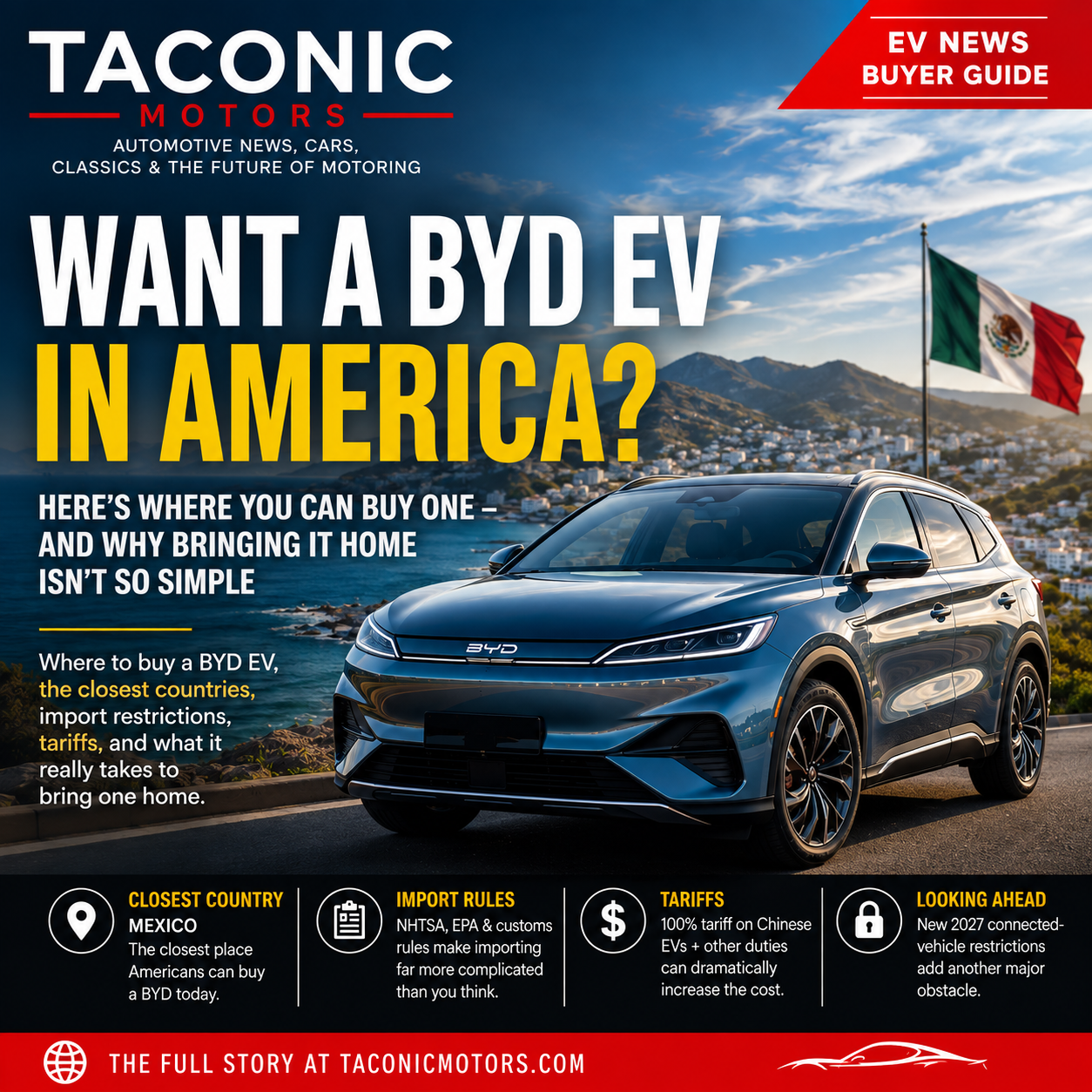
Want a BYD EV in America? Here’s Where You Can Buy One — and Why Bringing It Home Isn’t So Simple
Updated August 2026 | TaconicMotors.com
BYD has become one of the biggest names in electric vehicles worldwide. The Chinese manufacturer now sells everything from inexpensive urban EVs to high-performance sedans, SUVs and plug-in hybrids.
Yet there is one major market where you still can’t simply walk into a BYD showroom and buy one: the United States.
That raises an obvious question for American EV enthusiasts:
Where is the closest place to buy a BYD, and could you simply import one into the United States?
The short answer is that buying one isn’t particularly difficult.
Getting it legally registered for normal road use in the United States is another matter entirely.
The Closest Place to Buy a BYD
For an American buyer, Mexico is currently the closest established BYD passenger-car market.
BYD already operates an official Mexican dealer network and offers an impressive selection of electric and plug-in-hybrid vehicles.
The Mexican lineup currently includes models such as:
- BYD Dolphin Mini EV
- BYD Seal EV
- BYD Yuan Pro EV
- BYD Sealion 7 EV
- BYD King DM-i
- BYD Song Plus DM-i
- BYD Song Pro DM-i
- BYD Shark DMO
- BYD Atto 8
That means an American can travel to Mexico and actually see BYD vehicles at authorized dealerships rather than relying on an overseas vehicle exporter.
BYD’s official Mexican website also provides a dealer locator covering sales and service locations.
What About Canada?
For buyers in New York and the Northeast, Canada would obviously be much more convenient.
Canada has also dramatically changed its policy toward Chinese EVs.
In 2026, Canada replaced its previous 100-percent Chinese EV surtax with a tariff-rate quota allowing up to 49,000 Chinese-made EVs annually at a 6.1-percent tariff.
That has opened the door for Chinese manufacturers to enter the Canadian market.
However, despite considerable speculation about BYD dealerships and Canadian launch plans, BYD passenger vehicles are not yet established in Canada in the same way they are in Mexico.
That makes Mexico the practical answer today, while Canada is probably the North American market American BYD enthusiasts should watch most closely.
Can I Buy a BYD in Mexico?
Generally, yes.
The bigger question isn’t whether you can purchase the vehicle.
It’s whether you can bring it back across the U.S. border and legally register it.
And this is where things become complicated.
Can You Import a Mexican BYD Into the United States?
You cannot simply buy a BYD in Mexico, drive to the border, pay a customs fee and register it at your local DMV.
Vehicles permanently imported into the United States must comply with federal requirements administered by several agencies, including:
National Highway Traffic Safety Administration (NHTSA)
Federal Motor Vehicle Safety Standards.
Environmental Protection Agency (EPA)
Federal vehicle certification requirements.
U.S. Customs and Border Protection (CBP)
Customs entry, documentation and duties.
A foreign-market vehicle that wasn’t manufactured and certified for the American market normally cannot simply be permanently imported as an ordinary personal vehicle.
The 25-Year Rule Doesn’t Help — Yet
Car enthusiasts are probably familiar with America’s famous 25-year import rule.
Once a vehicle reaches 25 years of age, NHTSA generally allows it to be imported without having to comply with current Federal Motor Vehicle Safety Standards.
That’s why Americans can legally import older Nissan Skylines, Land Cruisers and other foreign-market vehicles that were never officially sold here.
Unfortunately, that doesn’t do much for someone wanting a new BYD.
You’ll be waiting a while.
A 2026 BYD wouldn’t reach its 25-year exemption until approximately 2051.
Could a Registered Importer Convert One?
In theory, certain nonconforming vehicles can enter the United States through a NHTSA Registered Importer, provided the vehicle is eligible for importation and can be modified to comply with applicable U.S. standards.
EPA requirements may also require involvement from an Independent Commercial Importer.
But this isn’t the same situation as converting headlights or replacing a speedometer on an overseas version of a vehicle already certified for America.
BYD does not currently sell an equivalent U.S.-certified passenger-car lineup.
That makes federal certification considerably more complicated.
For the average enthusiast, this is unlikely to be an economical route.
Then There Are the Tariffs
Even if all of the certification problems could be solved, there’s another substantial obstacle:
tariffs.
The United States raised its Section 301 tariff on electric vehicles originating in China to 100 percent.
And that is an additional tariff—not simply the normal customs duty you might associate with importing a foreign automobile.
Other automobile duties and trade measures can potentially apply depending on the vehicle’s classification, country of origin and the rules in effect when it enters the United States.
In other words, buying a $30,000 BYD overseas doesn’t mean you’ve found a $30,000 EV for America.
The potential duties, transportation, customs brokerage, certification and compliance work could destroy much of the price advantage that made the BYD attractive in the first place.
Buying It in Mexico Doesn’t Make It Mexican
This is an especially important distinction.
Buying a Chinese-built BYD from a dealership in Mexico does not automatically change the vehicle’s country of origin.
Driving it across the Mexican border doesn’t turn it into a USMCA vehicle.
Rules of origin determine where a product legally originates for tariff purposes.
Simply purchasing a Chinese-manufactured automobile in Mexico does not allow it to bypass U.S. tariffs imposed on Chinese vehicles.
Mexico itself introduced a 50-percent tariff on vehicles from countries without a Mexican free-trade agreement in January 2026, including China. Interestingly, Chinese brands have continued gaining Mexican market share despite the new tariff.
BYD remains one of the strongest Chinese manufacturers in the Mexican market.
An Even Bigger Problem Arrives With 2027 Models
Tariffs may eventually become almost secondary.
The U.S. Department of Commerce finalized rules restricting connected vehicles and technology linked to China and Russia.
The regulations cover technology that allows vehicles to communicate externally—including systems using cellular connections, Bluetooth, Wi-Fi and satellite communications.
Most modern EVs are essentially computers on wheels, making this particularly significant for Chinese EV manufacturers.
Beginning with Model Year 2027, U.S. rules prohibit certain sales or imports involving connected vehicles with covered software linked to China or Russia.
The regulations also prohibit certain connected-vehicle manufacturers with a sufficient nexus to China or Russia from selling new connected vehicles in the United States beginning with Model Year 2027.
Hardware restrictions become even stricter later in the decade.
For a company such as BYD, this creates a regulatory obstacle considerably larger than simply paying an import tariff.
Could BYD Eventually Sell Cars in America?
Never say never.
BYD already has an enormous international footprint, and its expansion outside China continues rapidly.
The company sells vehicles throughout Europe, Asia, Australia, Latin America and other global markets.
BYD also manufactures vehicles outside China, including at its expanding Brazilian operation.
But American regulations mean BYD can’t simply build a factory somewhere else, change the VIN and start shipping cars into the United States.
The connected-vehicle regulations specifically address manufacturers with a sufficient nexus to China, not merely the geographic location where the automobile is assembled.
That makes BYD’s potential entry into the American passenger-car market considerably more complicated.
Why American Automakers Are Watching BYD
Regardless of whether BYD cars reach American dealerships anytime soon, Detroit is paying attention.
BYD has demonstrated something extremely important: EVs don’t necessarily have to be expensive luxury vehicles.
The company’s strength comes from vertical integration, battery manufacturing, electric powertrain development and the ability to produce vehicles across an enormous range of prices.
The BYD Dolphin Mini is a particularly interesting example.
It’s a compact EV designed primarily as affordable transportation rather than a $50,000 technology showcase.
At the other end of the spectrum, vehicles such as the Seal and Sealion 7 demonstrate that BYD can compete in more sophisticated segments as well.
That’s arguably BYD’s biggest influence on the American market.
American consumers may not be able to buy one yet, but manufacturers competing globally against BYD can’t ignore it.
So What’s the Bottom Line?
If you live in the United States and simply want to see, test-drive or purchase a new BYD, Mexico is currently the closest established market.
For New Yorkers, Canada is geographically much closer and is becoming increasingly interesting following Canada’s reduction of tariffs on Chinese EV imports. BYD’s eventual Canadian passenger-car expansion would make seeing one far easier for Northeast enthusiasts.
But purchasing a BYD outside America and permanently importing it into the United States for everyday road use is a completely different proposition.
You potentially face:
Federal safety certification.
EPA requirements.
NHTSA import eligibility.
Customs paperwork.
Very substantial tariffs.
Connected-vehicle restrictions.
State registration requirements.
So while a weekend trip to Mexico could put you behind the wheel of a BYD, bringing that same car home and putting New York plates on it is currently another story.
For most buyers, the sensible strategy is simple:
Go see one. Drive one if you get the opportunity. But don’t buy one expecting to easily drive it home and register it in the United States.
The really interesting question isn’t whether Americans can privately import BYDs today.
It’s whether changing trade relationships, manufacturing locations and U.S. regulations will ever allow BYD—or another Chinese EV manufacturer—to compete directly in American showrooms.
Considering how quickly the global EV industry is changing, that’s a story worth watching.
Taconic Motors — Automotive News, Cars, Classics & the Future of Motoring
Regulations and tariffs change frequently. This article is intended for general automotive information and should not be considered legal, customs or importation advice. Anyone considering importing a vehicle should verify the specific VIN and model with CBP, NHTSA and EPA before purchasing the vehicle.