Best Used Cars for $5,000–$10,000 in 2026: Private Seller or Dealer?
That does not mean a dependable car is impossible to find. It does mean that buyers must be realistic, flexible and willing to pay for an independent inspection before handing over their money.
According to 2026 market reporting, the average used-vehicle listing price remains far above this budget. In practical terms, a sub-$10,000 shopper is looking below the center of the market, where condition and maintenance history vary enormously. The goal should not be to find the newest or most impressive vehicle. It should be to find the simplest, best-maintained vehicle with the cleanest history.
What should you expect for $5,000 to $10,000?
In the Hudson Valley and greater New York area, this budget will commonly lead to cars that are roughly 10 to 18 years old, often with 100,000 miles or more. Mileage alone should not automatically disqualify a car. A well-maintained 130,000-mile sedan with service records can be a much better purchase than a neglected 75,000-mile car with accident damage and no history.
At the lower end of the range, expect cosmetic wear, an older model year and the possibility of overdue maintenance. Closer to $10,000, you may find a cleaner compact car, a basic midsize sedan, a small hatchback or an older front-wheel-drive crossover.
Trucks, three-row SUVs, sporty cars and popular all-wheel-drive models usually command a premium. A cheap example can quickly become expensive if it needs tires, brakes, suspension work, exhaust repairs or transmission service.
The types of cars worth considering
These are broad shopping targets rather than guarantees. Prices differ by mileage, trim, condition, accident history and location.
Compact sedans
Compact sedans often deliver the best combination of fuel economy, parts availability and manageable repair costs. Reasonable candidates may include older examples of the Toyota Corolla, Honda Civic, Mazda3, Hyundai Elantra, Kia Forte and Volkswagen Jetta.
Do not buy solely on a reputation for reliability. Even a Corolla or Civic can be a poor purchase if it has been abused, overheated, damaged or poorly repaired. Conversely, a less fashionable model with complete maintenance records may be excellent value.
Midsize sedans
The decline in sedan popularity can work in a budget buyer’s favor. Older Toyota Camry, Honda Accord, Mazda6, Ford Fusion and Buick sedans may offer more room and comfort than a similarly priced small SUV.
Four-cylinder models are often the sensible choice because they typically use less fuel and can be easier to maintain. Inspect every individual vehicle carefully, since engine and transmission combinations can differ considerably across model years.
Hatchbacks and small practical cars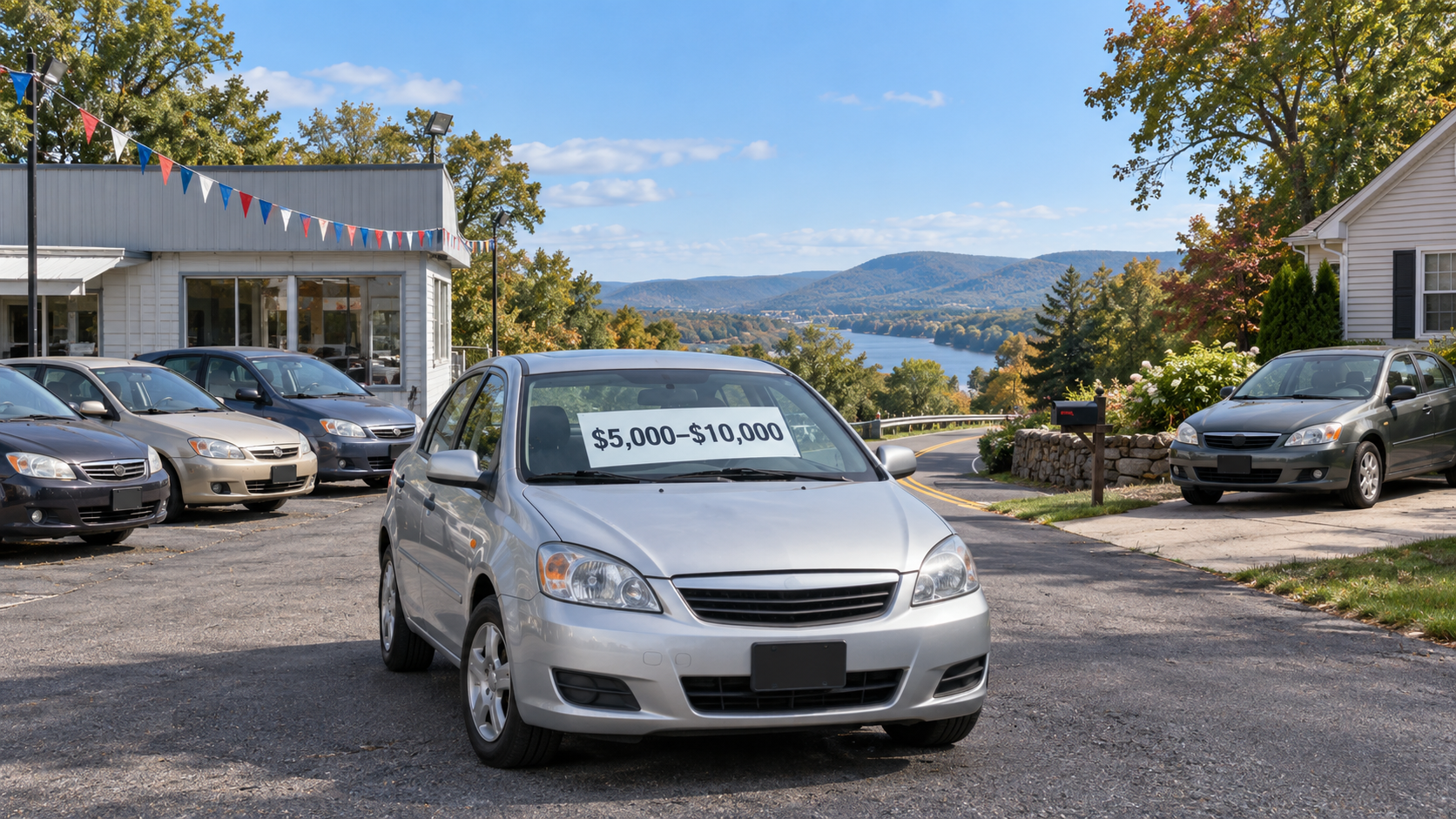
Cars such as the Honda Fit, Toyota Matrix, Pontiac Vibe, Mazda3 hatchback, Kia Soul and Scion models can provide SUV-like usefulness without the SUV price. Their folding rear seats make them surprisingly versatile.
The Honda Fit remains particularly appealing as a practical small car, although strong demand may keep clean examples above the lowest prices. Current 2026 reliability research also shows that viable sub-$10,000 choices still exist, but the available model mix is often older and narrower than buyers expect.
Older crossovers
You may encounter older Honda CR-V, Toyota RAV4, Subaru Forester and similar compact crossovers below $10,000. These vehicles are popular, so affordable examples frequently have high mileage, rust or deferred maintenance.
In New York, inspect the underside for corrosion. Pay close attention to subframes, brake and fuel lines, suspension mounting points and previous rust repairs. An all-wheel-drive badge is not worth much if the underbody is deteriorating.
Used electric cars
Older Nissan Leaf models sometimes fall comfortably inside this budget. They can work well as local second cars, but battery health and realistic winter range are crucial. A low purchase price does not make an older EV suitable for every driver. Have the battery condition checked and confirm that its real-world range covers your routine with a generous reserve.
Private seller or local dealer—which is cheaper?
A private seller will usually have the lower asking price. There is no dealership building, sales staff, vehicle preparation or retail overhead to cover. You may also be able to speak directly with the person who drove and maintained the car.
The disadvantage is risk. Private sales are generally made as-is, and the seller may not know—or disclose—the full extent of a problem. In New York, the state’s used-car lemon-law protection does not apply to a purchase from a private individual.
A private sale makes the most sense when the seller has a clean title in their own name, a believable reason for selling, consistent service records and no objection to an inspection at a shop of your choosing.
Is a dealer safer?
A reputable local dealer can offer more accountability and legal protection, but dealer inventory is normally more expensive. The advertised figure may also exclude documentation charges, taxes, registration and optional products, so ask for the complete out-the-door price in writing.
For qualifying vehicles bought from a New York dealer, the state’s used-car lemon law may provide a limited written warranty. Coverage depends on factors including price and mileage. Vehicles with more than 100,000 miles are not covered by that lemon-law warranty, and many wear items are excluded. Buyers should read the exact warranty rather than assuming that every repair will be covered.
A dealer is not automatically trustworthy simply because it has a physical lot. Check its reputation, inspect the car independently and review every fee. The Federal Trade Commission also requires dealers to display a Buyers Guide explaining whether a vehicle is being sold with a warranty or as-is where permitted. Keep a copy of that guide and make sure the final contract matches it.
Which option is better?
For the lowest possible purchase price, a carefully vetted private sale often wins. For greater legal protection and a more structured transaction, a reputable licensed dealer is usually the stronger choice—particularly when the car has fewer than 100,000 miles and qualifies for New York’s used-car warranty protection.
The best choice depends on the buyer:
-
Choose a private seller if you are comfortable evaluating cars, can verify the title and history, and will insist on an independent inspection.
-
Choose a dealer if you value consumer-law protections, easier paperwork, financing availability and a business you can return to if an eligible covered problem appears.
-
Walk away from either one if the seller refuses an inspection, pressures you to act immediately, cannot produce a valid title or gives inconsistent answers about the car’s history.
The inspection matters more than the sales channel
Before buying any vehicle in this price range, arrange a pre-purchase inspection with an independent mechanic. Spending roughly $150 to $250 before the sale can prevent a repair bill costing thousands.
Ask the mechanic to check:
-
Rust and structural corrosion
-
Evidence of collision or flood damage
-
Engine and transmission condition
-
Fluid leaks and warning lights
-
Tires, brakes, steering and suspension
-
Exhaust and emissions equipment
-
Heating and air conditioning
-
Battery and charging system
-
Upcoming maintenance, including timing-belt replacement where applicable
Also obtain a vehicle-history report, verify that the VIN on the dashboard matches the title and door label, and check the VIN for open recalls through the National Highway Traffic Safety Administration. A recall check is free, but it is not a substitute for a mechanical inspection.
Do not spend the entire budget on the purchase price
If your total budget is $10,000, consider shopping for a car priced around $8,000 to $9,000. Keep the remainder for tax, registration, inspection, insurance and immediate maintenance. An older car may need fluids, filters, tires or brakes soon after purchase even if it is fundamentally sound.
Avoid stretching the budget merely to obtain an SUV, a luxury badge or unusually low mileage. Complexity can be costly. A straightforward front-wheel-drive sedan with documented maintenance is often the smarter buy.
Final thoughts
The best $5,000-to-$10,000 used car in 2026 may not be the model you originally wanted. It is the car that passes an independent inspection, has a clean and verifiable title, shows evidence of regular maintenance and leaves money in your budget for the unexpected.
Private sellers are usually cheaper. Dealers can be safer from a legal and paperwork standpoint, especially in New York, but they cost more and still require careful vetting. Whichever route you take, buy the condition and history—not the story, the shiny paint or the badge on the grille.
Taconic Motors provides general automotive information, not legal, financial or mechanical advice. Prices and vehicle availability vary by location and change frequently.
Sources
Suggested keywords: used cars under $10,000, best used cars 2026, used cars under $5,000, private seller vs dealer, New York used-car lemon law, affordable used cars, Hudson Valley used cars, pre-purchase inspection