
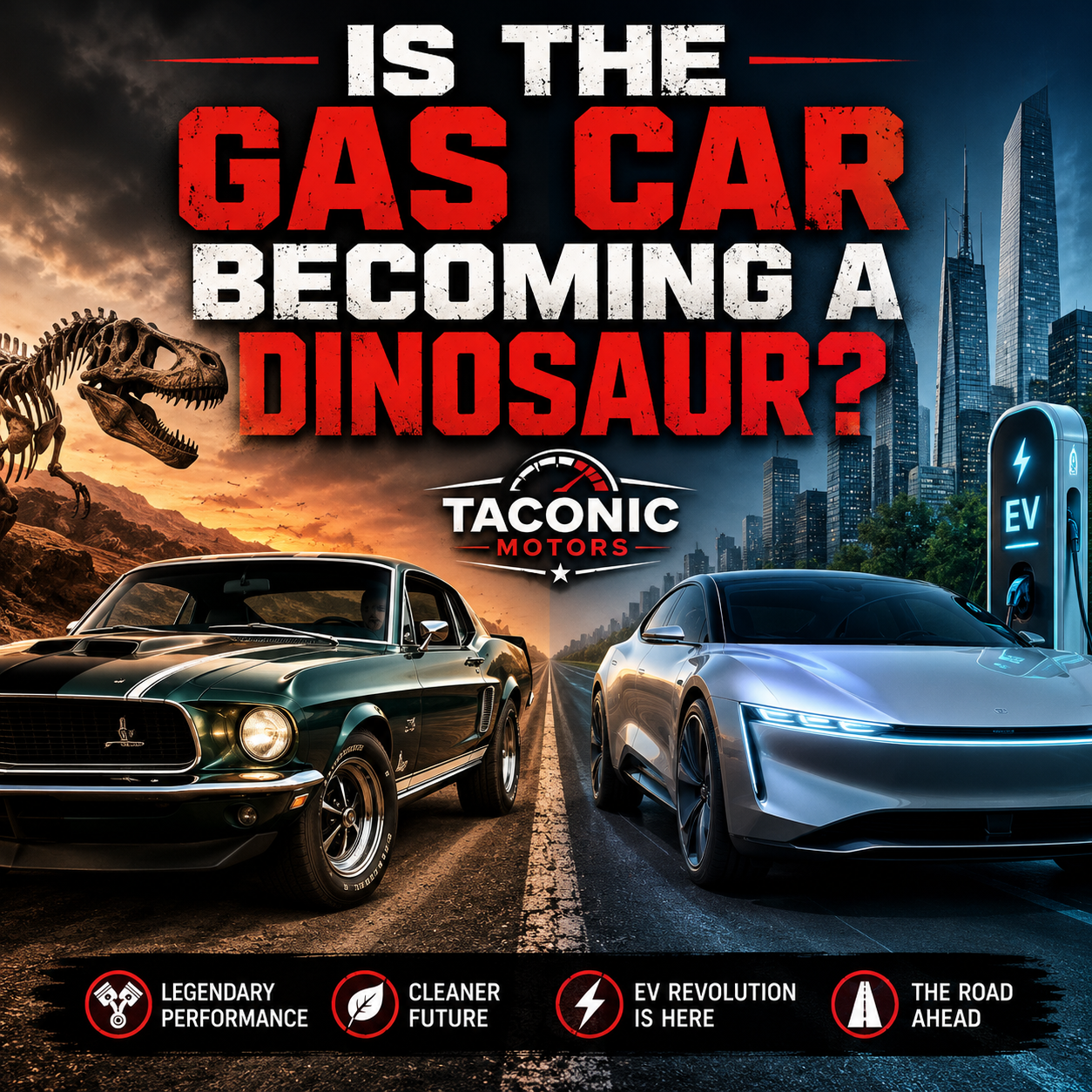
Is the Gas Car Becoming a Dinosaur? EVs vs Gas Cars in 2026
Is the Gas Car Becoming a “Dinosaur” Because of the Rise in Popularity of EVs?
For more than a century, the internal-combustion engine has been the beating heart of the automobile. Gas stations, oil changes, exhaust notes, transmissions and the smell of gasoline are all part of the culture of driving.
But walk around a modern auto show—or simply look at what’s appearing in showrooms—and the automotive landscape is clearly changing.
Electric vehicles are no longer strange experiments parked in a forgotten corner of the industry. They are mainstream products ranging from inexpensive city cars to luxury sedans, pickup trucks and seriously fast performance machines.
So, as we move through 2026, it raises an interesting question:
Is the gasoline-powered automobile becoming a dinosaur?
The answer is yes—but probably much more slowly than some EV advocates predicted.
The EV Revolution Is Real
Globally, the numbers are becoming difficult to ignore.
According to the International Energy Agency, electric-car sales grew about 20% in 2025 to more than 20 million vehicles. That means roughly one out of every four new cars sold worldwide was electric. The IEA expects EV sales to reach around 23 million in 2026, representing approximately 28% of global new-car sales.
That’s an extraordinary transformation for an industry that was overwhelmingly dependent on gasoline and diesel only a couple of decades ago.
China is particularly interesting. EVs accounted for nearly 55% of new-car sales there in 2025, while Europe reached approximately 28%.
The transition, however, looks very different here in America.
America Isn’t Giving Up Gas Just Yet
If you only looked at worldwide statistics, you might conclude that the gasoline engine is already heading toward extinction.
The United States tells a different story.
Electric vehicles represented just under 10% of U.S. new-car sales in 2025, and sales weakened sharply late in the year following major changes to federal EV incentives.
That means the overwhelming majority of Americans are still buying vehicles that have an internal-combustion engine, whether conventional gasoline vehicles, hybrids or plug-in hybrids.
There are also enormous numbers of gasoline-powered cars already on American roads. Even if EV sales accelerated dramatically tomorrow, replacing America’s existing vehicle fleet would take many years.
The gasoline automobile isn’t dead.
Not even close.
But Something Important Has Changed
Perhaps the better question isn’t whether gasoline cars are disappearing.
It’s whether the gasoline engine has stopped being the default technology of the future.
For most of automotive history, buying a new car automatically meant buying another internal-combustion engine.
Today consumers have genuine alternatives.
Battery EVs offer quiet operation, instant torque and fewer routine drivetrain maintenance requirements. Hybrids can dramatically reduce fuel consumption without requiring drivers to depend entirely on charging infrastructure. Plug-in hybrids provide another compromise.
And EV technology continues to improve.
The result is that the internal-combustion engine suddenly has something it hasn’t faced in more than 100 years:
serious competition.
Gas Prices Could Accelerate the Change
One of the biggest variables may not be environmental policy or government regulation.
It may simply be the price displayed on the sign outside your local gas station.
J.D. Power reported in its 2026 U.S. Electric Vehicle Consideration Study that rising fuel costs increased EV interest. In April 2026, 26% of new-vehicle shoppers said they were “very likely” to consider an EV, up three percentage points from the previous month.
That’s important because economics can change consumer behavior faster than ideology.
When gasoline is relatively inexpensive, a large SUV or pickup may seem perfectly reasonable. When filling the tank becomes significantly more expensive, the economics of charging an EV at home suddenly become much more interesting.
The IEA similarly notes that EVs generally benefit from lower running costs because electric drivetrains use energy more efficiently.
EVs Still Have Problems
If EVs were unquestionably better for every driver, the transition would probably happen much faster.
They’re not.
Charging remains one of the biggest concerns.
J.D. Power found that charging-station availability was the leading reason shoppers rejected EVs in its 2026 study, cited by 46% of respondents. Charging time was cited by 44%, while purchase price was another major concern at 42%.
For someone with a garage and home charger who drives 30 or 40 miles per day, an EV can be remarkably convenient.
Plug it in at night.
Wake up with a charged car.
Never visit a gas station.
But consider someone living in an apartment without dedicated charging. Or a driver regularly traveling hundreds of miles through rural areas. Or someone who needs to tow heavy loads.
For those motorists, gasoline or hybrid vehicles can still be extremely practical.
That’s why declaring the gasoline automobile obsolete in 2026 is premature.
The Hybrid May Be the Real Winner
There’s another possibility that sometimes gets lost in the EV-versus-gasoline argument.
Maybe the immediate future isn’t electric or gasoline.
Maybe it’s both.
Hybrids solve several problems simultaneously. Drivers get improved fuel economy without fundamentally changing the way they use their vehicle. There’s no requirement to install a charger, plan road trips around charging stations or wait for a battery to recharge.
You simply fill the tank and continue driving.
Meanwhile, the electric motor reduces fuel consumption and can improve low-speed performance.
For millions of drivers, that may currently be the easiest transition away from a purely gasoline-powered vehicle.
And that could mean the traditional non-hybrid gasoline car faces more immediate pressure from hybrids than from full EVs.
EVs Have an Environmental Advantage—But It’s More Complicated Than “Zero Emissions”
Electric vehicles don’t have tailpipes, but that doesn’t mean producing and operating them creates zero environmental impact.
Battery production requires energy and raw materials, while the electricity used to charge an EV must come from somewhere.
However, the U.S. Environmental Protection Agency says EVs typically produce a smaller carbon footprint than gasoline vehicles even after electricity generation is considered. The EPA also notes that although EV manufacturing—particularly battery manufacturing—can initially generate more emissions, lifetime greenhouse-gas emissions are typically lower than those of an average gasoline vehicle.
As electrical grids incorporate more renewable and lower-carbon generation, that advantage can increase.
What Happens to the Gas Station?
Here’s another interesting question.
If EV adoption continues increasing, what happens to America’s enormous network of gas stations?
They probably won’t disappear overnight.
Instead, they may evolve.
Highway service stations could increasingly combine gasoline pumps with high-speed EV chargers. Convenience stores may discover that EV drivers are particularly valuable customers because charging keeps them at the location longer.
The traditional five-minute gasoline stop could become a 15- or 20-minute coffee, food and shopping stop.
Ironically, tomorrow’s “gas station” may sell considerably less gasoline.
Performance Cars Are Changing Too
For enthusiasts, this is where the conversation gets emotional.
An electric motor can produce enormous torque instantly. Modern performance EVs can deliver acceleration that would have been considered supercar territory not long ago.
But speed isn’t the entire experience.
A great internal-combustion performance car communicates through sound, vibration, gears and mechanical feedback.
A classic V8 doesn’t simply move a vehicle.
It has character.
The same can be said for a high-revving naturally aspirated engine, an old air-cooled flat-six or a beautifully tuned European straight-six.
EVs may eventually dominate acceleration contests, but they cannot recreate the mechanical experience of those engines.
And perhaps they shouldn’t try.
Today’s Gas Cars Could Become Tomorrow’s Classics
There’s an interesting historical parallel.
When automobiles replaced horses, horses didn’t disappear.
Their purpose changed.
They went from everyday transportation to recreation, competition, collecting and passion.
Something similar could eventually happen to internal-combustion automobiles.
Imagine the automotive world of 2050.
The everyday commuter vehicle might be electric, possibly highly automated and extraordinarily efficient.
But on a sunny Sunday morning?
Someone will still open a garage door and fire up a 1968 Mustang.
Someone will still take an old Porsche through a winding mountain road.
Someone will still restore a Corvette, Alfa Romeo, Jaguar or Mercedes-Benz simply because they love the machinery.
Gasoline cars may gradually become less practical transportation and more mechanical entertainment.
And enthusiasts may treasure them even more because of it.
So, Is the Gas Car Becoming a Dinosaur?
In one sense, yes.
The automotive industry is clearly undergoing one of the biggest technological transitions since the invention of the automobile.
The IEA expects EVs to approach 30% of worldwide new-car sales in 2026, and under its current-policy scenarios the global EV fleet could grow dramatically over the coming decade.
But dinosaurs disappeared.
Gasoline cars aren’t about to.
Instead, we’re entering what may be the most diverse period in automotive history.
Gasoline cars.
Hybrids.
Plug-in hybrids.
Battery EVs.
And potentially other technologies still under development.
Consumers will ultimately decide which combination works best.
The Taconic Motors View
At Taconic Motors, we don’t think enthusiasts need to choose sides.
You can appreciate the astonishing acceleration and technology of a modern EV while still loving the sound of a classic V8.
You can admire a sophisticated hybrid drivetrain and still enjoy rebuilding a carburetor.
Cars have always evolved.
That’s part of what makes the automotive world fascinating.
The gasoline engine may eventually lose its position as the dominant form of everyday transportation, but that doesn’t mean it’s destined for extinction.
The gas car may be becoming a dinosaur—but some dinosaurs are going to be very collectible.
Taconic Motors — Cars, Classics, EVs and the Changing Automotive World